Insights · Megaproject of the week · 12.09.2026
A 2 GW campus with its own power station: where the fire risk moves
Aligned broke ground on a 2 GW data centre campus in Pennsylvania that runs on its own on-site generation instead of the grid. That single decision pulls a power plant inside the fence — and with it a set of fire scenarios most data centre fire strategies were never written for.
Project data
What happened
On 10 September Aligned Data Centers broke ground at Shippingport, Pennsylvania, on what its announcement calls “a new 2 GW data center campus”, spanning three facilities, on the grounds of the coal-fired station that ran there from 1976 until 2019. Holder Construction and Kokosing are named on the build. The announcement puts an estimated $10B of regional economic investment around the project — a figure about the region, not a construction budget.
Two lines in that announcement matter more than the money. The campus “will use its own dedicated onsite power source rather than the local electrical grid”. And it is “engineered to require zero water for operational cooling”, running a closed loop that “continuously recycles pure, deionized water”. Trade reporting describes the on-site generation as natural gas–fired, with an initial supply taken from a separate gas lateral rather than from the large conversion project planned elsewhere on the site.
Analysis: a power plant inside the fence
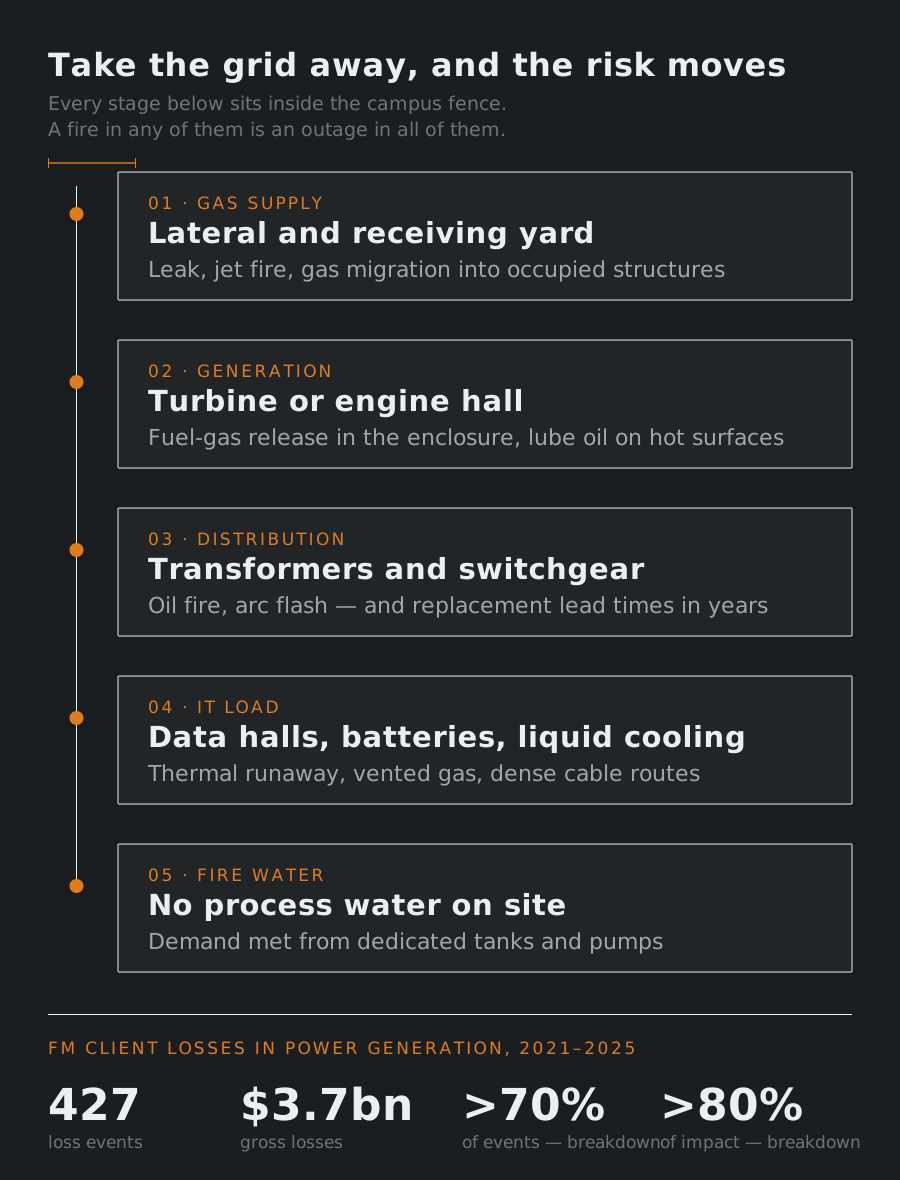
Behind-the-meter power is usually presented as a grid-queue problem solved by a commercial decision. In fire engineering terms it is a change of facility type. A campus that buys electricity is a building with electrical rooms. A campus that makes its own is a process plant coupled to a building, and the process side brings hazards that a conventional data centre fire strategy does not address: fuel gas inside enclosures, lubricating oil on hot surfaces, transformer oil, and — a scenario people forget until commissioning week — purging gas pipework on a live site.
Three consequences follow.
The governing scenario stops being a server-hall fire. With no grid behind the meter, a fire in the generation block is not a plant event, it is a campus outage. Availability, not property damage, sets the protection concept: separation and redundancy between power blocks become fire-engineering decisions taken at layout stage, when they are still free. This is the ground where NFPA 850 and NFPA 37 meet NFPA 75 and FM Data Sheet 5-32 — and where, in the European Union, the ATEX directives, the EN 50600 series and EN 12845 have to be made to agree with an owner’s insurer.
Hazardous-area classification arrives in a building project. Area classification to IEC 60079-10-1, gas detection with shutdown and ventilation interlocks, emergency isolation of the fuel supply, enclosure suppression, explosion relief, oil containment and transformer deluge are routine on a gas plant and alien to most data centre design teams. They are also not the kind of thing that can be bolted on after the layout is frozen; the separation distances they imply are consequence-driven and belong in the first site plan.
Water has to be re-planned. A zero-water cooling design removes the incidental inventory that fire strategies have quietly leaned on for decades. Fire water demand — transformer deluge, turbine hall, sprinkler and hydrant duty — now has to be met by dedicated tanks and pumps sized for the governing scenario, with the duration that scenario actually requires.
Why this reaches European projects
The same model is arriving in Europe, for the same reason: grid connection dates. Owners here will meet it inside a stricter frame — Seveso thresholds where fuel inventories justify them, ATEX obligations towards workers as well as equipment, CPR-conforming products, and insurers who now read data centres as a power-generation risk. FM counts 427 power-generation losses among its clients between 2021 and 2025, some US$3.7 billion gross, with mechanical and electrical breakdown behind more than 70% of events and over 80% of financial impact; it notes that replacement lead times for gas turbines and transformers are measured in years.
For anyone planning an off-grid or partially off-grid campus, the questions worth asking before the concept is fixed are narrow: which single fire takes the whole load down, what separation does the credible jet fire or transformer fire actually demand, how the fuel supply is isolated, and what fire water duty the site must hold when nothing else on it stores water.
Sources
- Aligned Data Centers and Shippingport Community Mark Revitalization of Legacy Energy Site with Groundbreaking of 2 GW “Project Phoenix” Campus — Aligned Data Centers, via GlobeNewswire, 10.09.2026
- Aligned Data Centers to develop data centers at Shippingport Industrial Park, Pennsylvania — Data Center Dynamics, 03.02.2026
- Aligned Breaks Ground on $10B, 2 GW Data Center in Beaver County — Marcellus Drilling News, 11.09.2026
- Power generation risks mount as electricity demand soars — FM, 15.07.2026
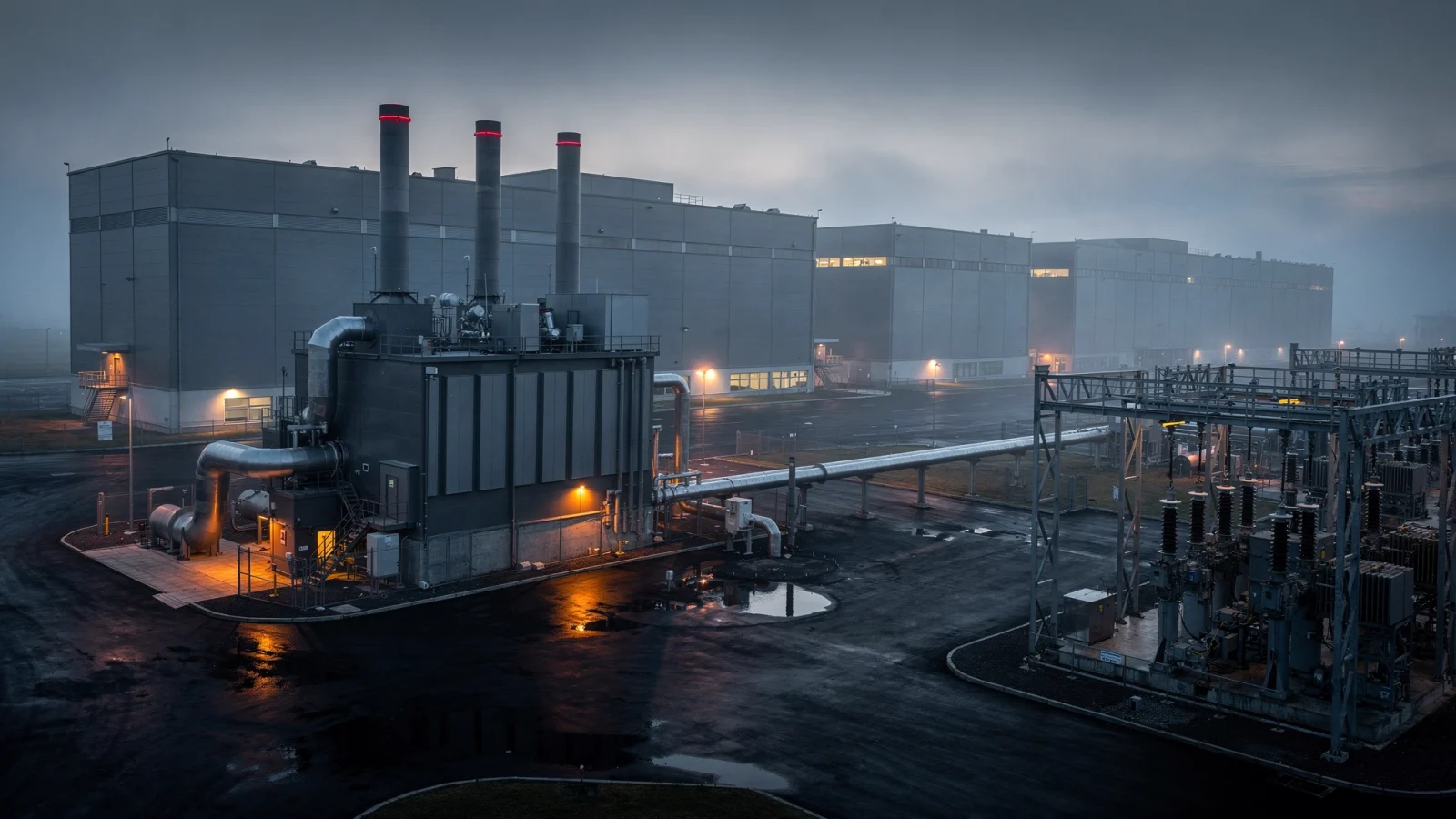
Editorial rule, applied without exception: no figure, designation or claim of fact is published without verification against a primary source. Everything under “Analysis” is our engineering judgement, not reported fact. Illustrations are generated images, not photographs of the facilities described.